Posts

Showing posts with the label Study Tips

SC Week 5/6: All (Simple) Chess All The Time

Image
  "When faced with any problem too large to cope with as a single entity, common sense tells us to break it down into smaller fragments of manageable proportions." Michael Stean

BtM 11A: On the importance of knowing stuff

Image
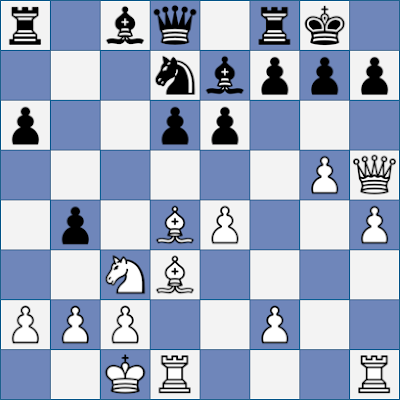
April 1988, Position C White to play Short - Ljubojevic, Reykjavik 1987 Contributions are welcome in the comments box. I’ll reply with what the Masters have to say about their choice to anybody who suggests a move.

BtM 6A: Pattern recognition (aka When to plant a tree)

Image
December 1988, Position B White to play Szalanczy - Gavrikov, Hungary 1988 Contributions are welcome in the comments box. I’ll reply with what the Masters have to say about their choice to anybody who suggests a move. Scroll down to see some commentary from me and the Masters’ feedback. . . . . . . . . . . . . . . . . . . . . It is my firm belief that intuition does not develop as random pattern recognition, but rather the recognition of patterns previously investigated and understood. That is why looking through unannotated games from a database or playing through the complete works of Averbakh will not seriously improve your chess. Jacob Aagaard:  Excelling at Positional Chess It’s worth listening to Aagaard when he’s got something to say about chess improvement. For my money he’s one of the better chess writers of our time. A time that has given us, let us not forget, several dozen books by the Mrs B...

BtM 5A: ’78 bishops

Image
June 1988, Position D White to play Romanishin - Psakhis, Yurmala 1987 Contributions are welcome in the comments box. I’ll reply with what the Masters have to say about their choice to anybody who suggests a move.

How to Use This Blog

Image
Ho w should you use this blog? Well, any way you want to is the TL;DR / short version (delete according to your age group). Comments are always welcome. Especially if your choice of move is accompanied with a description of the thought process that lead you there.  I’m going to post on Monday and Friday each week. Each one will start with a position from one of those old Beat the Masters articles. There’ll be some wibble from me to follow and the points and a list of which Master chose which move will be at the end. If anyone comments with their choice of move, I’ll reply with what the article had to say about it. So, use this material however you find useful. In case of interest, here’s what I do:- set up the position on a real board; analyse without moving the pieces as deeply and thoroughly as I can manage; write down my thoughts as moves and ideas occur to me;   eventually decide on my choice and write that down along with the time ...

BtM 1: Is the Sicilian Defence Different?

Image
June 1988, Position G Black to play Contributions are welcome in the comments box. I’ll reply with what the Masters have to say about their choice to anybody who suggests a move. Scroll down when you’re ready to see what the Beat the Masters panel chose and the points scored for each move. . . . . . . . . . . . . . . . . . . . . I remember my friend Tom telling me that playing Open Sicilians was good for developing players back in 2008 around the time he wrote this blogpost . He was one of the best improved adult chess players in England that year, and I knew the idea originated from Rowson, so what he had to say was obviously worth listening to. Not that I did. In my defence, my objection was partly practical. You might want to play Open Sicilians, but in club chess - at my level anyway - you’re far from guaranteed to get 2 Nf3 and 3 d4 after you answer 1 e4 with 1 ... c5 . I don’t know the answer to the question raised by the title of ...

The Abysmal Depths of Chess

Image
A few months ago, I advised a student of around 2000 strength to try to analyse one complicated game deeply and carefully. I asked him to keep on honing and revising his findings until he felt confident that I wouldn’t find any major mistakes in his analysis. I encouraged him not to use analysis engines until he had given it his best effort. He was not allowed to make generalizations about the position and not allowed to stop with the assessment that the position was 'unclear' unless he could demonstrate the effort he had made to find clarity.  He is a diligent student and keen to improve, but looking at a complicated game in depth until he understood it move by move, variation by variation, proved to be too much for him. He devoted a few study sessions to this task, a couple of hours at a time, but he came back to me and said that he was 'scared' to do any more. Whenever he tried to look at the position without prejudices he felt 'lost' and 'helples...